
Your breakers protect the wiring in the walls. They do nothing for the electronics plugged into it. A surge device at the panel is what covers those.
Lightning gets the blame, and it is the dramatic one. But the surges that actually wear out your electronics are generated a few feet away, dozens of times a day.
Every time a motor stops or starts it puts a spike back onto the circuit. The air conditioner, the well pump, the refrigerator compressor, the garage door opener. Small, frequent, and cumulative.
These do not kill a device in one event. They degrade the power supplies inside it until something fails early and nobody connects the two.
Lightning during monsoon season, and utility switching on the grid outside. Rarer, far larger, and capable of taking out several things at once.
A device at the panel is sized for these. It is also the only thing standing between the service conductors and everything downstream.
Protection at the panel handles what arrives from outside. Point-of-use strips handle what is generated inside the room. They are layers, not alternatives.
Almost everything expensive in a modern house now has a circuit board in it.
Control boards in a furnace, a heat pump or a refrigerated air unit. Among the most expensive boards in the house to replace.
Common out in Corrales, Placitas and the North Valley, and genuinely disruptive when the controller fails.
LED drivers are sensitive to repeated small surges. Lamps failing early is often the first visible sign.
Ranges, washers, dishwashers and EV charging equipment all run on boards now, and all sit on circuits a strip never reaches.
A surge device needs two adjacent breaker spaces and a short, direct path to the ground bar. Whether your panel has those decides what gets installed and what it costs.
A surge device works by diverting energy to ground. If the grounding electrode or the bonding is not right, the device cannot do its job, and that is worth knowing before you buy one.
Power down, mount the device, land it on its own breaker with the leads kept as short as the installation allows, and confirm the indicator before closing up.
The indicator tells you the device is still protecting. It is the one thing in the panel worth glancing at occasionally, and we show you where it is before we leave.
It is one of the smaller jobs we do, and the price depends mostly on what the panel allows rather than on the device itself.
Every figure is a starting point · Written itemized estimate within 24 hours
They protect what is plugged into them, and nothing else. They do not cover the air conditioner, the furnace, the well pump, the range or anything else hard-wired, which is where the expensive boards are. A panel device covers the whole service, and strips then handle what is generated inside the room.
No, and anyone who tells you otherwise is selling something. A direct strike is beyond what any panel device is rated for. What it does handle is the far more common case, which is a nearby strike coupling onto the lines, plus everything the utility and your own motors put on the circuit.
It wears out by doing its job. Each surge it absorbs uses up some of its capacity, and the indicator light tells you when it is spent. In a house with a lot of motor load it may need replacing sooner than in a quiet one.
Usually two adjacent breaker spaces. If your panel is full, that becomes part of the conversation, and sometimes it is the point at which a panel upgrade makes more sense than working around the problem.
Often more so, because older houses frequently have grounding that was adequate for the code of the day and is not ideal now. We check that first, because a surge device with nowhere good to send the energy is not protecting much.
It depends on the jurisdiction and on whether other work is happening at the same time. We tell you which applies before we start, and we pull the permit where one is required.
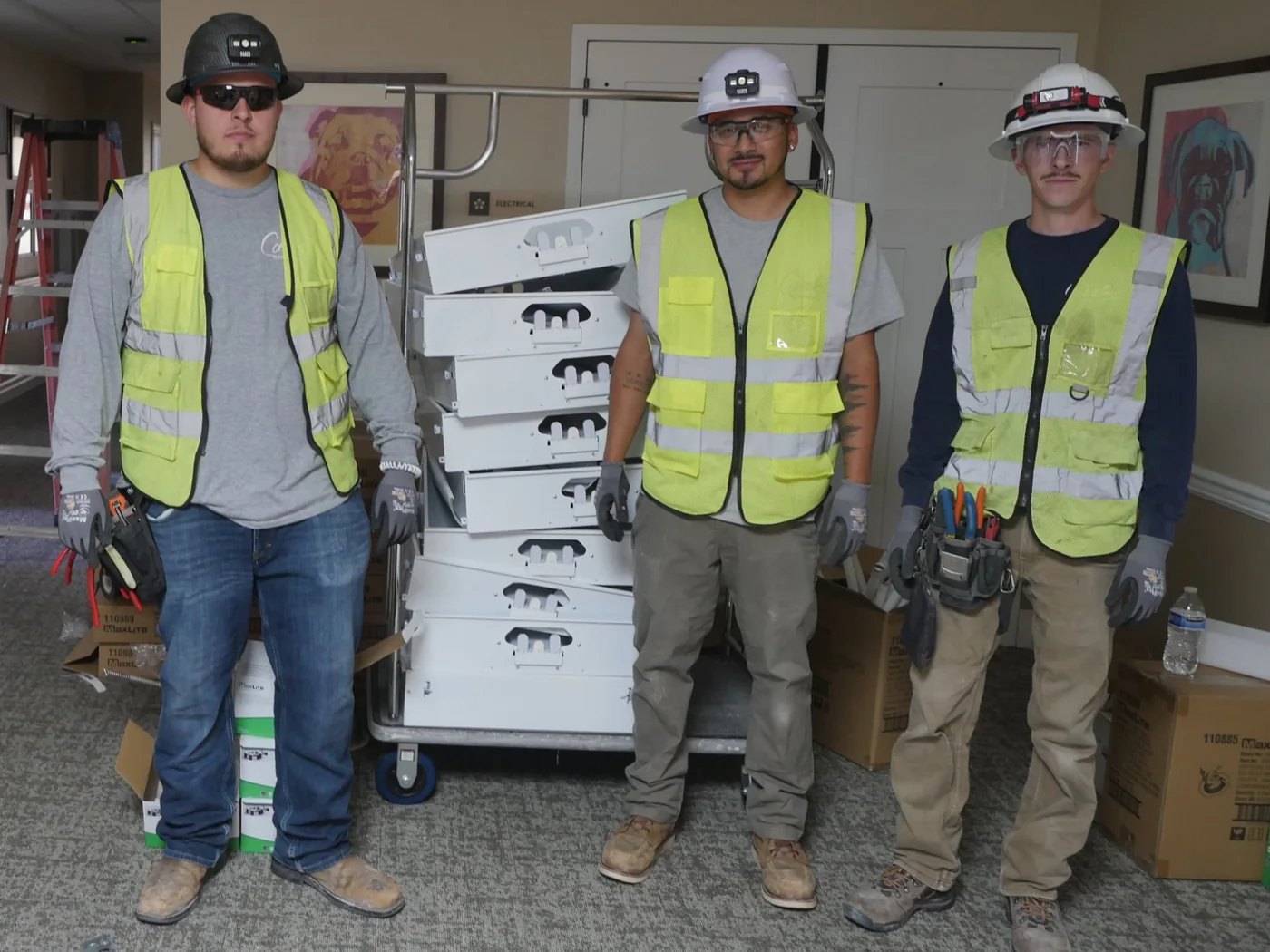
We work inside banks, secured facilities and on-base jobs, and those accounts do not let an unvetted crew through the door. Every one of our electricians clears a background check before they work for us, and again every year after that.
For a panel replacement that means the person switching off your power has been checked by somebody other than us. Almost no residential electrician in this market can say that.
We cover the metro, and the name should not make a homeowner in Los Lunas wonder whether we drive out.
A panel replacement is the cheapest time to add surge protection, because the panel is already open.
Different devices, different jobs. One guards against shock and fire, the other against voltage spikes.
The full range of repair and safety work, from a dead circuit to a written safety inspection.
Written, itemized estimate within twenty-four hours from Brad or Brian. Calls answered after hours. Payment due on completion; no financing offered.