
Path lights, uplighting and wall fixtures that survive a New Mexico summer and a monsoon season. Wet-location rated, GFCI protected, and buried deep enough that a shovel does not find them.
Rarely the fixtures. It is water getting into a connection that was never rated for it, a transformer sized for the run it started with rather than the one it became, and cable buried at whatever depth suited the person with the shovel.
Wet-location fixtures and weatherproof connections at every splice. A connection in a planter bed is a connection underwater several times a year.
Low-voltage runs sized for their actual length. Voltage drop is why the far end of somebody else's run looks dimmer than the near end.
Buried at depth and routed where a shovel is least likely to find it. We tell you where it runs, so the next person planting a shrub has a chance.
A transformer with headroom. Adding four more fixtures next spring should not mean replacing it.
Permitted where the work calls for it, and inspected the same as everything else we do.
Four jobs. They need different circuits and different fixtures.
Low-voltage path lights along a walk or a drive. Usually the first thing people add, and the easiest to extend later if the transformer was sized for it.
Uplighting on walls and portals, or wall fixtures either side of a door. Line voltage or low voltage depending on the fixture.
Well lights and uplights set into beds, where the fixture lives in wet soil and the connection matters more than the lamp.
Motion fixtures and floods on a garage or a yard. A different job from landscape lighting, and usually a different circuit.
What you want lit looks different at night, and so does what is already lit. Worth doing before anything is quoted.
Fixture positions, how many, and what each one is mounted to or buried in.
For the length you are installing and a little more, so adding to it later does not mean starting again.
Buried at depth, weatherproof connections throughout, and GFCI protection on the circuit.
Fixtures get aimed while they are on, not in daylight. That is the difference between lighting and glare.
Priced by the number of fixtures and the length of the runs, plus whatever the ground makes us do to get there. Caliche and mature tree roots cost more than lawn.
Every figure is a starting point · Written itemized estimate within 24 hours
Low voltage for most landscape work. It is safer to work around planting, easier to extend, and the fixtures are smaller. Line voltage still makes sense for wall fixtures and floods.
Deep enough to meet code for that cable and that location, which is deeper than most of the do-it-yourself runs we get called out to repair.
That is what wet-location fixtures and weatherproof connections are for. Most outdoor lighting failures we see are water in a connection that was never rated to be wet.
Usually. The first question is whether the existing transformer has capacity left, and the second is what condition the buried run is in.
A new exterior circuit does. Adding fixtures to an existing low-voltage run generally does not. We will tell you which yours is before we start.
Yes. Photocell, astronomic timer or a controller you run from an app. Worth deciding before the transformer is chosen rather than after.
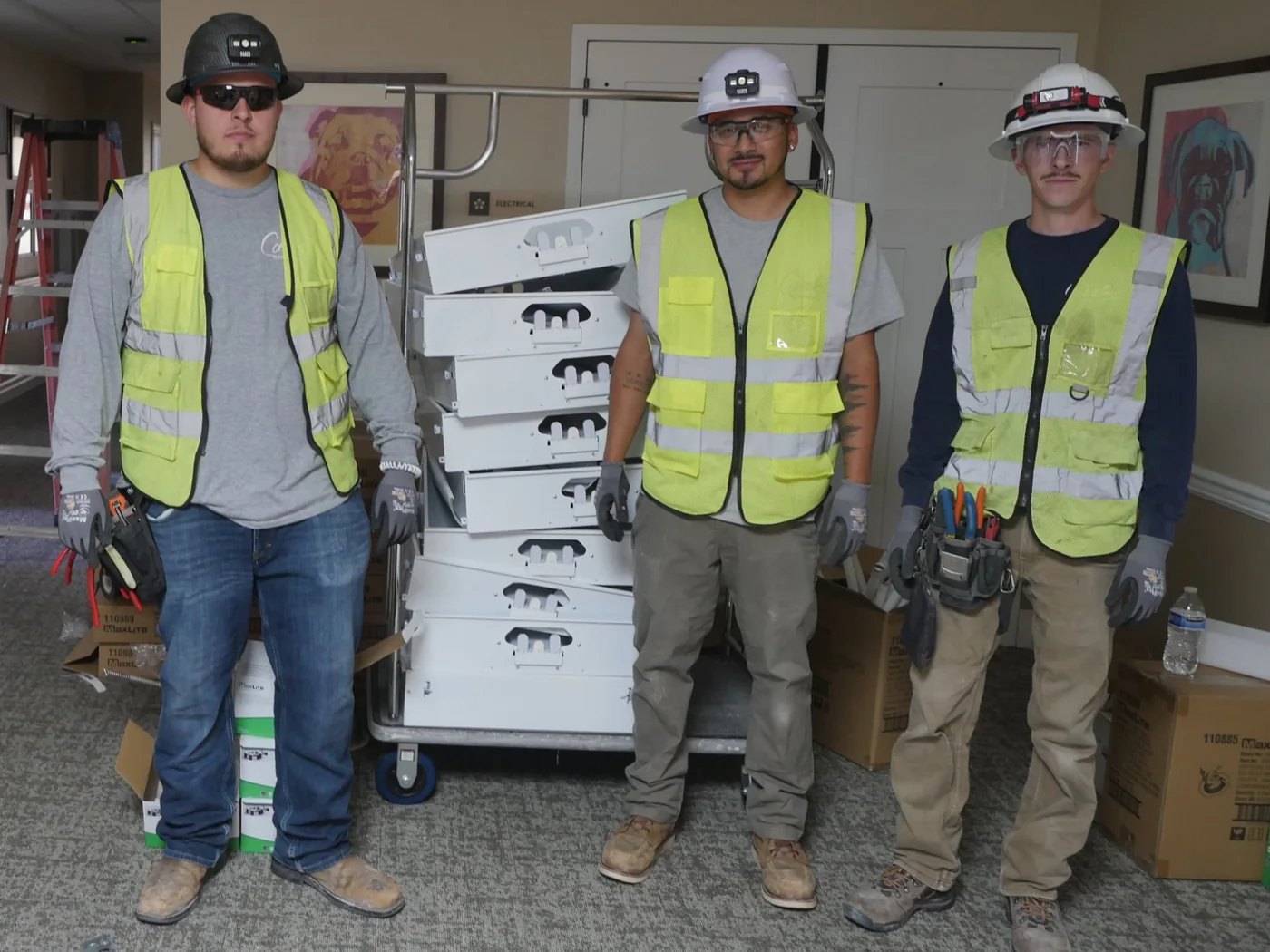
We work inside banks, secured facilities and on-base jobs, and those accounts do not let an unvetted crew through the door. Every one of our electricians clears a background check before they work for us, and again every year after that.
For a panel replacement that means the person switching off your power has been checked by somebody other than us. Almost no residential electrician in this market can say that.
We cover the metro, and the name should not make a homeowner in Los Lunas wonder whether we drive out.
Written, itemized estimate within twenty-four hours from Brad or Brian. Calls answered after hours. Payment due on completion; no financing offered.