
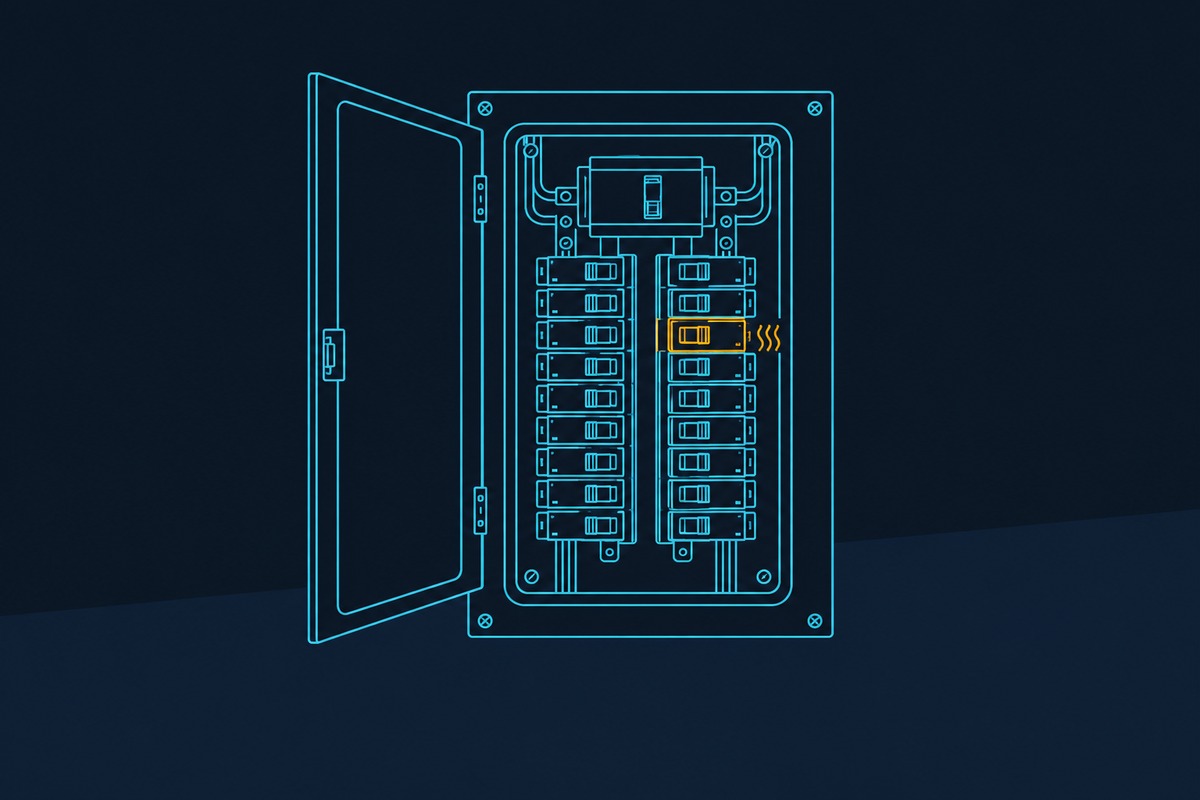
Your electrical panel needs replacing when it shows heat damage, makes noise, trips breakers that won't stay reset, or is a brand and age that no longer protects your wiring. Some of those signs mean shut the breaker off and call today. Others mean plan the replacement this year.
We are Corrales Electric, a family-run electrical contractor in Albuquerque since 1992. We replace panels across Albuquerque, Rio Rancho, Corrales, Bernalillo, Placitas and Los Lunas. Here is how we tell the two kinds of warning apart, and what we find when we open the box.
The story below is a composite of jobs we see regularly. The details repeat often enough that it's worth telling.
A homeowner calls because one breaker keeps tripping. It's the den circuit, and it goes every time the vacuum and a fan run together. They figure it's an overloaded circuit or a weak breaker. Their plan is to swap in a higher-amp breaker so it stops tripping.
We open the panel and find two problems.
The homeowner's plan was the fix that had already caused the damage. A breaker exists to protect the wire behind it, not the appliance plugged into it. Upsize the breaker without upsizing the wire, and the wire becomes the weakest part of the circuit. That's how a nuisance trip turns into a panel replacement.
These signs mean heat or arcing is happening right now. If you see one, switch off the affected breaker, or the main if you can't tell which, and call us.
Don't open the panel cover to look. The parts that fail are the parts still energized.
These signs aren't a midnight emergency. They mean the panel is worn out, obsolete, or too small for how you live now.
Albuquerque's housing stock is old: roughly a quarter of homes were built between 1940 and 1969. The age of your house predicts what's in the panel more reliably than anything else.
| BUILT | WHAT WE USUALLY FIND | WHY IT MATTERS |
|---|---|---|
| 1930s–1950s, older valley homes | Fuse boxes rated 30 to 60 amps, often feeding later sub-panels added without permits | Piecemeal remodels leave mixed wiring, including cloth-insulated runs, tied to modern circuits |
| 1950s–1970s | Federal Pacific Stab-Lok and Zinsco panels | Breakers that may not trip on an overload or short. The panel can look fine for decades. |
| Mid-1960s–mid-1970s | Aluminum branch wiring from the copper-shortage years | Aluminum expands and contracts under load, loosening terminals and causing arcing at the panel and outlets |
| 1960s–1970s tract homes | Original 100A service | Adequate for 1965. Central air, a modern kitchen and an EV charger push it past its limit. |
| 1990s–2000s, Rio Rancho and the West Side | Panels in good condition, sized for the house as built | The trigger here isn't failure. It's added load: a hot tub, EV charger, casita or generator. |
If you know roughly when your house was built, you already know where to start.
Sometimes the sign isn't in the panel at all. It's in a letter.
The home inspection flagged it. During a sale, an inspector spots an obsolete panel, a Federal Pacific or Zinsco box, or double-tapped breakers. The repair goes into the report, and the replacement becomes a condition of closing.
The insurance carrier won't renew. Some carriers stop covering homes with obsolete panels and set a deadline for replacement.
Either way, you're working against a date. Tell us the closing or renewal date on the first call. We schedule the permit, the utility disconnect and the inspection around it.
What you get at the end is what the buyer, the lender or the carrier will ask for:
Once you know the panel has to go, you'll likely get more than one quote. One may come in well under the others. Here's what Brad Palmerton, our operations manager, tells homeowners at the kitchen table:
“Look, I completely understand wanting to keep costs down. $1,500 is real money. But that discount isn't coming from them being more efficient. It's coming from skipping the safety checks, the utility coordination and the legal paper trail. If something goes wrong down the line, or when you try to sell this house, that $1,500 savings is going to cost you ten times over.”
A panel replacement done properly needs three things: a permit, a utility disconnect and reconnect, and an inspection. Ask whoever gave you the cheaper quote which of the three they're handling. If the answer is none, it isn't the same job at a lower price. It's a different job, and the inspector who walks through when you sell will notice.
Not unless the wire is sized for it. The breaker's rating has to match the wire it protects. A bigger breaker on the same wire lets the wire overheat before anything trips.
Typically 25 to 40 years. Age alone isn't a reason to replace a panel that's working, but it's a reason to have it looked at.
Yes. A panel replacement needs an electrical permit, coordination with the utility to disconnect and reconnect power, and an inspection before it's signed off.
It depends on what the house runs. A load calculation answers it. If you're adding central air, an EV charger or a hot tub to a 100A service, plan on the calculation saying no, and on a service upgrade to 200A.
If your panel matches anything on the call-today list, switch off the breaker and call 505-585-4894. You'll get Brad or Brian.
If it's on the plan-this-year list, we'll come out and give you a written, itemized estimate within twenty-four hours. We pull the permit, coordinate the utility disconnect and handle the inspection.
Wondering what the paperwork involves? Every panel replacement in New Mexico needs an electrical permit and an inspection.
CORRALES ELECTRIC INC. · NEW MEXICO ELECTRICAL CONTRACTOR LICENSE #52188 · LICENSED, BONDED AND INSURED · FAMILY-RUN SINCE 1992
Written, itemized estimate within twenty-four hours from Brad or Brian. Calls answered after hours. Payment due on completion; no financing offered.